Search

Custom Search

Wednesday, December 1, 2010

The Importance of Having a Will

from daveramsey.com  
 
Estate planners tell us that nearly 70% of Americans die without a will. Folks, this is dumb – really dumb. If you hate the people in your life, die without a will, because you're going to tie them up for years.
A will is a gift you leave your family or loved ones. It is a gift because it makes the management of your estate very clear and light-years easier. If you don't have a will, the state (not known for its financial prowess) will decide what happens to your stuff, your kids, and your financial legacy. You don't want this to happen. Even if you're single, get a will right now!

The Legacy Drawer

Making a will is one of the best things I've done for my wife, Sharon. We have what is called my Legacy Drawer. It is a file drawer in our study that has everything one of us would need if something happened to the other one. It has letters of instruction on everything in there: a full will, a full estate plan, all of our investments, copies of insurance information, etc. A 12-year-old could read through it all and know exactly where things are and what everything is. Learn how to set this up in MyTotalMoneyMakeover.com.

How to Get a Will

The easiest and most cost-effective way to go about making a will nowadays is to use one of the online legal services. I recommend USLegalForms.com, which offers state-specific wills created by professional attorneys for public use. All you need to do is fill in your information, and the will is tailored for you.
You can also contact a good estate attorney; however, that will cost a bit more money. Typically, with your attorney, you can create mirror-image wills. That way, if one of you dies, the surviving spouse will get the entire estate. Everything is pretty much the same in both wills, with the exception of simply switching the names – hence mirror-image will. That is what Sharon and I have.
Also, after someone has died, 98% of the time I recommend that the survivors keep the will and all related papers for seven years. But double check with an estate attorney.
This is something we all need to be doing. You are going to die, so go out in style, and die with a will in place.
Need a will? Get a will today with USLegalForms.com.

DIY Monogram Mugs

November 22, 2010
DIY monogram mug
Friends! I’m so pleased to share our first gift DIY of the season. Maude made these fantastic monogrammed mugs over the weekend. Don’t they look terrific? The idea came when we saw these fun initial cups at Anthropologie and remembered our kitchen was lacking in hot cocoa mugs. We decided to create a whole set.
It’s a very doable project. Inexpensive. Eco-friendly. And family-friendly too — these mugs are dishwasher safe. I can’t wait to tell you all about it.

1) We started with a trip to Goodwill, where we collected 8 plain white mugs. Enough for the entire family. There was even a little one without a handle that we thought would be perfect for baby food for June. Mugs were 50 cents each and we had dozens and dozens to choose from.
DIY monogram mug
2) Then we gathered supplies. Scissors, pen, tape, graphite transfer paper, Black Pebeo Porcelaine Pen in Fine Point ($4 at Michaels, also available here) and a print out with the family’s initials.
For the font, I had something very specific in mind. I love the look of this Sketch Block Font and had it mentally filed away as the sort of thing a kid could replicate well — because it’s inherently imperfect. For this project, it worked like a charm! Since we were adding our own sketchiness, I started with a similar, but non-sketchy Rockwell font. Look for any slab-serif font (with names like Egyptian or Glypha) and they should work equally well.

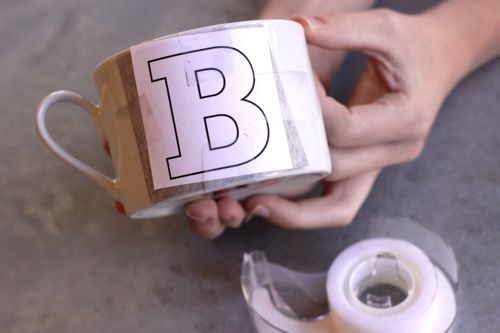
3) Cut out an initial and a piece of transfer paper. Tape the initial and the transfer paper (dark side down) to the mug.
DIY monogram mugDIY monogram mug
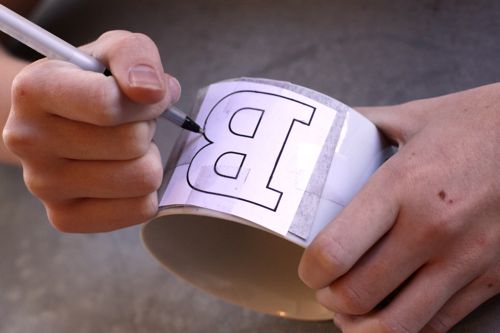
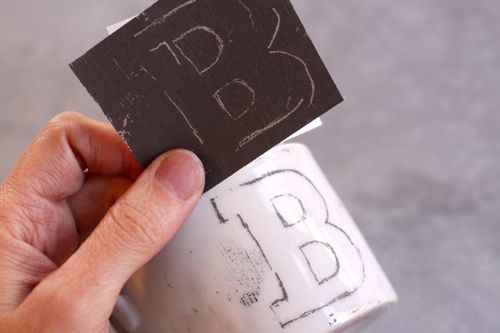
4) Trace the initial. Any pen or pencil will work and you’ll want to experiment with different pressures to see what’s best. You’ll just need a light outline. If you want, you can make your own transfer paper by rubbing a graphite pencil all over a sheet of plain paper.
DIY monogram mugDIY monogram mugDIY monogram mug
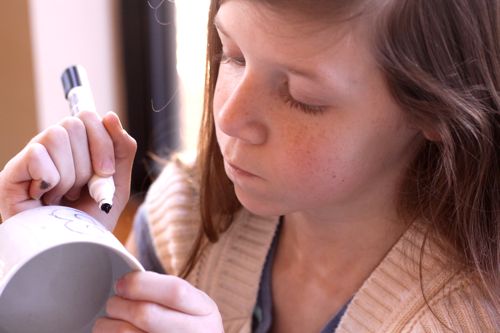
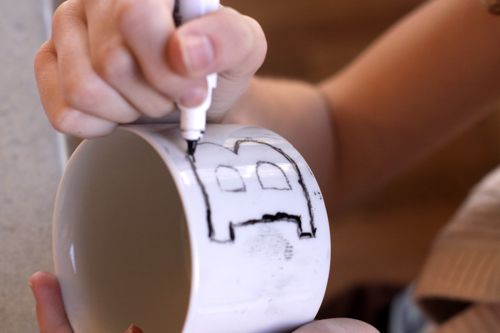
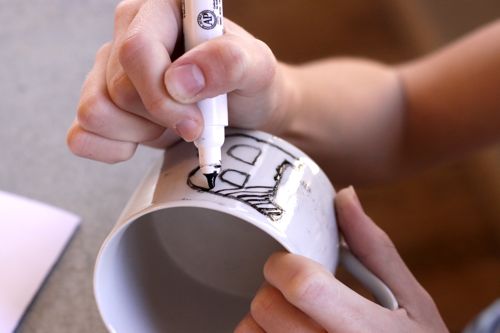
5) Take your Porcelaine pen and trace over the lines of the initial. Get the edges nice and thick then fill in with diagonal sketchy strokes. A few notes:
- The sketchy strokes look best if they’re all one direction.
- The pen didn’t produce very smooth lines for us — which was fine because of the sketchy nature of the lettering. But later, I tried a red Porcelaine pen and produced very smooth strokes. So, I’m thinking my black pen was an old, dried out one. Who knows? This was my first experience with Porcelaine, so I’m not sure.
- It helped to have a blank paper handy where we could test the paint pen.
- We definitely got better at it as we practiced. So plan on it. Until it’s baked, the paint will scrub right off in soap and water. We redid mugs at least 4 times.
DIY monogram mugDIY monogram mug
6) Once the lettering is done, let the mugs sit for 24 hours. Then bake them at 300 degrees for 35 minutes. It’s fine to bake them with graphite residue. The graphite will wipe right off even after they’re done baking.
DIY monogram mugDIY monogram mugDIY monogram mug
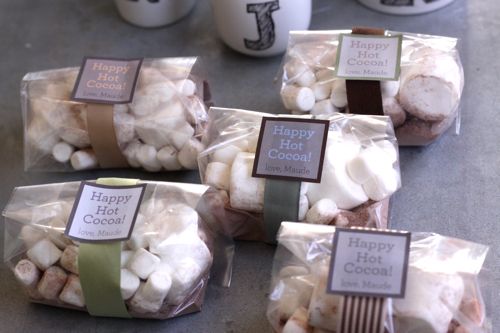
7) And that’s it! Once they’re baked, they’re done. We pulled them from the oven, wiped them up and they were ready to go. For fun, we filled cellophane bags with hot cocoa mix and marshmallows and put them in the mugs.
DIY monogram mug hot cocoa packagingDIY monogram mug
The project turned out so well that it has my mind spinning with other possibilities. Maybe we’ll make a monogrammed mug for their teachers with a Starbucks card inside. Or a matching 2-cup set for Grandma and Grandpa. Fun for Christmas, but equally fun for other events too.
What do you think? Is this a project your kids would enjoy? Are the mugs cool enough that you would buy one in the store if you saw it for sale?
P.S. — You can find links to gifts we’ve made in past years here.

Thanks Design MOM
After a suggestion (Thanks Monique!) that I try coconut oil in my homemade deodorant recipe, I started mixing it up today.
INGREDIENTS:
2 1/2 tbsp of Spectrum Organic Coconut Oil (The Virgin Coconut oil is what smells like yummy coconuts. This one doesn’t smell.)
2 tbsp cornstarch
1/2 tbsp baking soda
5 drops vitamin E (for moisturizing purposes)
3 drops essential oil (for smell)
I heated my coconut oil in the microwave because the liquid is easier to mix than the solid. I combined the ingredients in a pyrex measurement cup and stirred it well until blended.
Use your finger to apply.
As the coconut oil dries, it becomes thick and solid. I added Aura Cacia essential oil to my deodorant because it is my favorite. Baby food jars/containers are the perfect container to reuse for this as well. I have to admit that I like this recipe MUCH better than my former petro jelly version! It’s cheaper than buying store bought deodorant as I can make about 7 containers with just 1 jar of coconut oil!
This would make a great homemade Christmas gift!
Please respect that this recipe is intended for personal use and not for sale.

Tuesday, November 30, 2010

10 mistakes people make with heat


thermostat
(Photo: Getty Images)
Even with a constant flow of information about energy efficiency, homeowners make major heating mistakes that end in higher electric bills and larger environmental footprints.
Here are 10 of those errors, with the cause and effect of each decision.

1. Maintaining a constant temperature
Cause: A persistent myth suggests that you can save energy by leaving the house at a comfortable 68 degrees (a widely recommended winter setting), even when you are sleeping or away at work.
The idea is that it takes more energy for the furnace to reach a comfortable temperature than to maintain that temperature.
Effect: You could miss out on significant potential energy savings by not using a programmable thermostat and adjusting the temperature overnight and during the workday.
Though the impacts of adjusting the thermostat vary based on your climate and other factors, studies show that knocking the temperature down by 10 degrees for eight hours per day can cut heating bills by 5 to 15 percent.
Sure, the furnace will cycle on for a longer period to return to the more comfortable temperature, but it will be far outweighed by hours of savings when it didn't have to work as hard.

2. Cranking up the temperature to warm up the house
Cause: You come home in the middle of the day to a cold house. You want to warm back up to 68 ASAP, so you crank the dial up to 78 to get the furnace working harder and faster.
Effect: No time is saved in reheating the house. Most furnaces pump out heat at the same rate no matter the temperature. They just cycle on for a longer period to reach a higher temperature.
The furnace will take the same amount of time to return to 68 degrees regardless of the thermostat setting. By cranking up the thermostat, you are likely to overheat the house past 68 degrees and waste energy. Just reset the thermostat to 68, make some hot chocolate, and wait.
[ Learn how to get the most out of a programmable thermostat. ]

3. Closing off vents in unused rooms
Cause: You don't want to waste energy heating rooms you aren't using.
Effect: Again, this just wastes energy and makes your furnace run inefficiently because it changes the air pressure in the whole system.
Experts recommend never shutting off more than 10 percent of vents. Sealing your ducts is a more efficient way to save energy.
 
4. Using the fireplace
Cause: You found some free firewood on Craigslist and think you can burn up some free heating energy while enjoying a romantic fire.
Effect: While we can't make any promises about increased romance, we can predict increased energy bills. An open fireplace flue may suck more cold air into the house than the fire can radiate into the living space.
 
5. Using electric room heaters
Cause: You spend most of your time in a couple of rooms, so you figure you will just heat them with space heaters.
Effect: This could lead to higher energy bills and greater fire risks. Generally, a central gas heating system is cheaper and more efficient than a set of electric room heaters. Electric heaters also can be a fire hazard.
There are exceptions. A single energy-efficient space heater in a small, well-insulated room can save energy if the central heater is switched off.
[ Learn how to use space heaters efficiently. ]
 
6. Switching to electric heating
Cause: Electric heaters are more efficient than fuel-based systems, so they must be cheaper and better for the environment, according to this popular idea.
Effect: In most areas, simply switching to electric heat leads to higher energy bills and a bigger carbon footprint. Your heater may be more efficient, but most U.S. homes are still linked to coal-fired power plants. These coal plants and their transmission systems are extremely inefficient.
Of course, it's a different story if you have a large photovoltaic solar array or your utility company uses renewable energy.
 
7. Replacing the windows
Cause: Those big pieces of glass get so darn cold. They must be the reason your house is so drafty.
Effect: You could spend a lot of money to only take care of part of the problem. Windows must be installed properly to avoid drafts, gaps, and leaks.
Moreover, more heat is typically lost through poorly insulated walls and ceilings than through windows.
 
8. Replacing the furnace first
Cause: You blame high energy bills on an old, inefficient furnace.
Effect: Your energy bills will still be higher than necessary if you don't start with cheaper, smaller upgrades to improve the energy efficiency of your home, such as caulking around windows and doors and adding insulation.
 
9. Upgrading to the most efficient furnace on the market
Cause: You want the sleekest, most energy-efficient furnace available because it will be the most cost effective as well.
Effect: You may end up replacing an over-sized furnace with another (albeit more efficient) over-sized furnace. The U.S. Department of Energy reports that most U.S. homes have over-sized HVAC systems.
Again, insulate and weatherize to maximize efficiency, then get the smallest system that will comfortably meet your heating needs, which will be substantially reduced. Also make sure it is professionally installed.
 
10. Using incandescent light bulbs for heating
Cause: Incandescent bulbs give off more heat than light, so they must be warming up the house.
Effect: It is hard to see this logic as anything but a weak excuse for holding on to the Edison bulbs rather than switching to CFL and LED lighting.
In fact, one German entrepreneur is marketing incandescent bulbs as "heat balls" to skirt EU laws against the old-style bulbs. However, I doubt he is keeping cozy this winter simply by sleeping with the lights on.

Do-It-Yourself: Homemade Fleece Scarves and Hats

by Crystal on November 30, 2010

Saving Family Green shows you how to easily make Fleece Scarves and Hats.

Monday, November 29, 2010

5 Things to Play on a Cold Wet Day

Mon, Nov 29, 2010


Whether your kids have a cold or it is cold, heart-pounding playtime — the good kind — isn’t always possible outdoors during inclement weather.
In the winter months, moms like me can have a tough time keeping their busy kids from getting bored, especially when said kids are used to living it up covered in mud.
Too wet to go out
And too cold to play ball.
So we sat in the house.
We did nothing at all.
Dr. Seuss
Rather than just sitting there wishing for something to do, here are some out-of-the-box ideas for your Thing One and Thing Two:

1. Blanket Forts

Best made in low-traffic areas and avoiding blockading the entrance ways (because neither rain nor snow will keep the mailman away), blanket forts create a secret world within familiar walls. Simply connect sturdy pieces of furniture, such as chairs, by draping blankets over them.  Flashlights, goldfish crackers, a good stack of library books and secret knocks make fort living even more fun.

2. Roller Skating

With groovy music playing, turn your concrete basement floor into a roller skating rink. You know your kids like to run in circles through the kitchen, living room and dining room. Wheels will wear them out even quicker! If you’re feeling particularly adventurous, you can dust off your own skates and teach them hot numbers such as Disco Duck and the Hokey Pokey.  (Shh…. I never used headgear and knee pads when we used to do this as kids, but you may want to strongly consider it to reduce the injury factor. Remember : Potty emergency or not, absolutely NO skates on the steps!)

3. Bathtub Snow

Fresh, beautiful snow is an insult to injury for kids who are stuck indoors recovering from the flu. A solution? Bring the snow to them! It will take a little bit of work on your part, but, using a five gallon bucket, scoop up several loads of snow. Leaving the drain open, on that off chance it just might get covered and you have to be the one to open it when playtime is over, dump the snow into the bathtub. Break out the beach toys so that your kids can carve sculptures and cities out of snow. Sand molds work beautifully with this medium. If you care at all about your bathroom floor, you may choose to put down some towels as knee cushions, topped with a waterproof painter’s tarp. Hot chocolate with marshmallows is the afterward preferred treat.

4. Swinging Indoors

Baby swings are often hung in interior thresholds, but older children can safely swing so long as the frame of the door has thick, wooden support (not plaster!) and the swing is very securely bolted into place. (Admittedly, I am stealing this idea from my dad. He installed a swing for us kids in the threshold of our kitchen. I can still remember watching the snow falling outside of our windows as the sun went down, while listening to the Carpenter’s Christmas album.)  Be sure there is plenty of room in front and behind the reach of the swings.  Hallways are perfect.

5. Nerf War

Slightly safer than rubber band guns and way more fun, playing with Nerf Guns is one of my favorite ways to roughhouse without leaving a mark… from getting shot, at least. Best of all, starting an all-out, sweaty, indoor war is easy. Simply start shooting squishy foam darts (mine glow in the dark) at your kids while they’re trying to play video games. Bring it!
I hope you enjoy these ideas, and look forward to hearing some of your own!
One last thing — All of these activities are a million times more fun when performed costumed in items from your post-Halloween raid of the dollar store combined with the clothes mommy and daddy used to wear in their former lives.
Follow author Sarah Joy on Twitter here: @mrsalbrecht

Everything You Need to Know About Christmas Trees

By Stacy Johnson | about 5 hours ago

Watch the video above – read the story below
There’s nothing that says “holidays” like a Christmas tree. If you haven’t gotten yours yet, here are some quick tips to buy it right. If you have, here are some tips to keep it fresh through New Years.

Real Christmas Trees

When I was a boy growing up outside of Atlanta, Georgia, for several years in a row my father bought live Christmas trees, then planted them in the yard after the holiday. Both my youth and my father are now gone, but those trees remain to this day. If you’ve got the room in your yard and a green thumb, getting a live tree and planting it on New Years Day is a great way to start the year and preserve Christmases past. A local nursery can help you find the right tree and offer advice on keeping it healthy through the holidays and planting it in your yard afterwords.
If that sounds a little ambitious, but you still like the idea of a real tree, the second best idea is to cut your own tree at a Christmas tree farm. If you’re lucky enough to live near one, pile the family into the car and head out: Here’s a nationwide directory of tree farms.
If you’re buying from a tree lot, the price, availability and tree types will depend on where you live, but you’ll often find the best deals at warehouse stories like Home Depot and Lowe’s. That being said, don’t forget that small merchants deserve to survive too. If you like the idea of seeing Christmas tree lots springing up this time of year, remember that they won’t if everyone buys their tree from Home Depot. See if the guy on the corner will match or come close to the warehouse store price. As with most things in life – especially things that are perishable – the price is negotiable.
If you’re bringing your tree home on the top of your car, bring some cardboard along to protect your ride.
You can also buy a tree online: more convenient, but probably more costly as well. Here are six sites that sell trees…
  1. Tannenbaum’s Christmas Trees
  2. Touch of the Mountain Christmas Trees and Greens
  3. Christmas Trees Now
  4. Omni Farm
  5. Silver Mountain Christmas Trees:
  6. Paine’s Christmas Trees:

Buying a cut Christmas tree

  1. Choose the place you’re putting the tree and take some measurements. Height is obvious, but don’t forget the width of the doors you’ll be going through or the area of the room you’ll be putting your tree in. You’ll want to keep your tree as far away as possible from heat sources like vents, fireplaces or radiators.
  2. The sooner you buy one the better. Ask the dealer when their trees were cut: the fresher the better. Many people assume that getting a tree early is a bad idea, because it might wither and start shedding needles before New Years. While this seems logical, a cut Christmas tree is only going to last so long – it doesn’t care whether it’s sitting in a lot down the street or in your living room. In other words, once it’s cut, it’s cut, so put it in your home as soon as possible. Buying early also means better selection.
  3. Do your own freshness test: As you saw in the video above, there are several things you can do to test the freshness of a Christmas tree: first, grab a branch by the needles and pull it – the needles should stay on. Next, bend a branch and see if it’s supple: ideally it should bend without snapping. Finally, pick up the tree and drop it to see how many needles shake loose: the fewer the better.
  4. Inspect the base – ever brought home that perfect tree, only to find that the base isn’t straight and the tree leans to one side? Me too. That’s why now I make sure the last foot of the trunk is totally straight.
  5. Look at it again before you bring it inside – make sure there’s no insects or other unpleasantness hiding in the branches. Pick it up and drop it again.

Making your tree last

Properly cared for, your cut Christmas tree should last well over a month. Here’s what to do…
  1. When you buy your tree from the lot, they’ll cut an inch or so off the bottom – get the tree into water as soon as possible.
  2. When it comes to making a Christmas tree last, water isn’t the main thing: it’s the only thing. Use a stand that holds as much water as possible, then keep it filled at all times. If the bottom of the trunk is exposed to air, resin will form over it and it will no longer be able to absorb water: game over. Check the water supply every day without fail. To make your life easier, get a funnel, connect it to a short length of tubing that empties into the stand, then hide it all in the branches when you’re not using it.
  3. You don’t need distilled or other specialty waters, nor do you need chemical preservatives. Tap water is fine – just make sure the supply is sufficient.
  4. Remember that heat is not your friend – if your Christmas lights generate heat, use them sparingly and always turn them off at night. Miniature lights produce less heat than bigger ones.

Artificial Christmas Trees

In my opinion, an artificial Christmas tree has all the holiday charm of a gift card. But that’s me. If you like the ease, simplicity, lower long-term cost and infinite variety of artificial trees, go for it.
If you want to read way too much about selecting an artificial Christmas tree, Home Depot has you covered. But here’s the down and dirty:
  1. Have a budget: While overall cost is obviously important, remember that buying a good-quality tree means spreading that cost over many years. Buying a cheap tree that you don’t like might ultimately mean wasted money when you throw it away and start over.
  2. As with a live tree, decide where you’re going to put your tree and take some measurements. Be sure and leave a foot or so at the top if you’re going to add your own star or other topper.
  3. The more branches, the better. With a high-quality tree, you’ll have trouble seeing the trunk.
  4. Look at the stand: metal is better than plastic. And it should have rubber feet to keep from scratching the floor.
  5. How big is the box? You’re going to be storing it – make sure you have room.
  6. If possible, find out how difficult it is to set up and take down. Hinged branches are better than those that you have to attach individually to the trunk. Pre-lit is much easier than one you have to light yourself.
  7. Check out the box and see what the tree is made from. PVC plastic is the highest quality.
  8. To get the best deal, buy it after Christmas. Get a real tree this year, buy your artificial tree at an after-Christmas sale for half price.