Search

Custom Search

Wednesday, November 24, 2010

Free Ideas for New Thanksgiving Traditions

Learn the meager beginnings of several popular Thanksgiving traditions and get some free ideas for new traditions you can start with your family this year!

The Holidays are coming, along with many family traditions. Traditions are a great way to bring families closer together and create lasting memories that youngsters cherish through adulthood. With Thanksgiving around the corner it’s fun to look at some famous traditions that surround this holiday, and some of the not so famous.

Eating Turkey: Americans eating turkey on Thanksgiving probably found it’s root in what we affectionately call the “First Thanksgiving”. The original Plymouth Colonists from England found the land of the Wampanoag full of wild turkey. Both the Colonists and the natives ate turkey often. Coupled with it’s wide availability, it is highly probable it was the main dish of the celebration of plenty.

Watching football: For the most part, the tradition of watching football on Thanksgiving can be traced back to 1880’s where New England high schools had large rivalry games between schools. All that fun lead to the triumph of big appetites and a renewed gratefulness for the large meal.

Parades: Gimbel’s Department store in Philadelphia claim the fame in starting Thanksgiving day parades. These type of parades have been happening all over the states as early as the 1920’s. As their popularity grows, the design and spectacle of these events get bigger every year. There are many different events like this all over the country, but the widest known is the Macy’s Day Parade in New York City.

Giving Thanks Around the Table: Many families make it a tradition to go around the dinner table while eating and name something they are grateful for. Answers vary due to age and what stage of life a person may be in. Regardless of the living situation, the most popular answers usually include family, friends, a home, and food of course!

While these Thanksgiving traditions are widely popular and celebrated all over the country, it’s important for families to make every holiday their own. Here are 2 fun ideas that you can use to start your own traditions.

Christmas Cards: Most people send their Christmas cards the day after Thanksgiving. When we start receiving those Hallmarks in the mail it’s a surefire sign the Santa is soon to follow. Instead of simply buying a box of Holiday cards from the store, why not use this as a great craft activity with the family? Spend a day out in nature picking up some of those beautiful leaves. Use these leaves between 2 piece of trace paper and color over with an unwrapped crayon for some leaf impressions. Write a note and sign for a wonderful homemade Christmas Card!

The Gratitude List: Every year ask your family to sit down and write something the are grateful for. Rewrite these things on a piece of pretty fall stationary next to the family member’s name and put in a dollar store frame to hang in your house for all to see. As children grow, their answers will get more mature. Adults will see a change in priorities. Don’t forget to write the year on the back of that stationary so you can look back later on and remember that Holiday.

If you’re single, married, have kids, or an empty-nester, it’s never too late to create a Thanksgiving tradition or two. Just remember to enjoy the change of season and give thanks for all your blessings!

How To Distinguish a Sale from a Rip-off

By: Stacy Johnson


Black Friday is nearly upon us, a time when adrenalin often overtakes common sense. Today Lifehacker published an article detailing the tricks unsavory merchants use to reel you in and steps you can take to fight back.

Tricks they use

  • Discounts based on inflated prices: This is something we talked about last year in Tips for Outlet Mall Shopping - it may say “50% Off!” but 50 percent off what price?
  • Rebates: This is something we discussed just last week in 5 Tips to Win the Rebate Game. If you don’t get the rebate, you didn’t save anything – and many people don’t jump through the required hoops to get one.
  • Liquidation Sales – Avoid them like the plague. They’re often put on by specialty liquidation companies that inflate original prices and otherwise suggest you’re getting a much better deal than you actually are.

Your Defenses

  • Make a list – If you get lured into an impulse buy, you have only the merchants word that it’s truly a good deal. Make a list and buy only what’s on it.
  • Research, research, research – The best (in fact the only) way to know if you’re getting a good deal is to research prices and comparison shop before you’re standing in a store staring at a 50% off tag.
  • Technology – If you have a smart phone, you have the ability to scan a bar-code and see if the deal you’re seeing is truly a deal, or if you can buy it elsewhere for less. For Android phones, Lifehacker recommends Milo for Android and Pic2Shop. ShopSavvy is an app for both iPhones and Androids, and any phone that gets the Internet can use Google Product Search for Mobile.
That’s just some of the tips Lifehacker put in their article – check out How to Figure Out When a Sale Isn’t Really a Sale
 "A Harvard study found that for every hour of television per week you watch, you spend, on average, an extra $200 a year." —Dave Ramsey

How To Prepare For Black Friday

Black Friday experts from around the Web share their tips and advice on everything you need to know before you get in line.
Black Fiday
Before you line up outside Best Buy in the dead of night, before you clip out coupon after coupon, even before you review our best of Black Friday deals, there’s prep work to be done for every retailer’s favorite day of the year. We got in touch with Black Friday experts and collected their thoughts on how best to ready yourself for consumer battle.

Don't Forget the Little Guys
It’s easy to get lured in by names like Target, Walmart, and Best Buy. These retailers pull out all the stops when it comes to Black Friday, with full page ads and national press. Their reputations precede them, and accordingly result in very, very long lines. Lines that tend to be filled with the most determined shoppers. If you’re thinking about snagging one of those 40-inch Westinghouse TVs at Target, Jon Vincent of Black Friday.info says you will “need to get in line Wednesday night.”
But it’s not futile for those who want to take advantage of the one-day deals without missing the Thursday holiday; you just need to strategize. If you aren’t stuck on any of the big stores’ door busters, Vincent as well as Bfads‘ Michael Brim advises hitting up smaller office supply retailers like Office Depot and Office Max. Both will have worthwhile electronics discounted, like the Magellan Roadmate 3045 navigation system for $99.99 at Office Depot. Riddle mentioned a netbook for $179 at Radio Shack. The lines are short (sometimes non-existent), the staff less stressed, and there’s a decent array of tech gifts to choose from. Sam’s Club is even offering free breakfast to customers diligently waiting in the cold. You won’t find that at Target this year.
Consider Staying Home

More from DigitalTrends.com: 
Mike Riddle of Black-Friday.net laughs when asked if he’s standing in lines come November 26. One year, he stood in line all day at Best Buy for the store’s door buster TV discount, and once he got in, they were all out. Then he went home and bought it on Amazon.
Vincent echoes Riddle’s sentiment, “Ask yourself, ‘is it worth it?’” He doesn’t think so. Brim agrees that Amazon offers not only the same discounts, but the time and anguish you spend on Black Friday are eliminated. The site promises to match all discounts, and Riddle reports that the site will knock two cents off in-store prices. Add to this that Amazon will be running price cuts starting Monday the 22, its free shipping policy for purchases over $25, and no sales tax, and you’ve got yourself a pretty convincing argument to sit at home on Black Friday.
Dev Shapiro of GottaDeal.com disagrees. He will be among the discount devotees outside Best Buy as early as 6 a.m. Tuesday morning. Shapiro says until consumers are guaranteed that online shopping sites’ servers won’t crash or the items they want won’t sell out in minutes, it's best to “do it the old-fashioned way” – get in line.
On that note, here’s an insider’s tip: Anyone out there interested in Best Buy’s $99 Nook, it’s suspected Amazon will offer the Kindle for the same price starting Monday.

Do Your Homework

If you’re going to do Black Friday, you better do it right. The first step is doing your research. Shapiro’s advice is to search a coupon site, retailer’s site, and individual product’s sites. He points out that ads will show you how much you’re saving on an item, but not how much it’s actually worth. “A store might be overstocked on a product, maybe they just need to clear out the warehouse, avoid getting taxed on something that’s been sitting there. So they throw it out for Black Friday.”
It’s also important to take details into account. Shapiro pointed out that this year’s Target Westinghouse TV is certainly a steal at $298, but buyers should note that it only has one HDMI port. So you have to decide whether you connect your Blu-ray or DVD player, cable box, or video game console. Or, you need to factor in the cost of another hookup, which runs between $100 and $200.
And do this research in advance. Don’t even think about leisurely pawing through the coupon pages on Thanksgiving – get your product’s specs and serial number down, know how many a store will have available, and have an image as well. Black-Friday.net will organize this list for you, if the idea of putting it all together yourself is a little overwhelming.
Timing is Everything

If your heart is set on one of the big name retailers, timing is crucial. This year’s Black Friday build up is primarily focused on Walmart, Target, and Best Buy, with Kmart and Staples also getting some attention. While all our experts agree it varies depending on the size of your town and what items you want, the general consensus on when to line up for doorbuster items is sometime between Wednesday evening and early Thursday afternoon.
Also, realize that you are limiting yourself to one store. Sure, there are the super humans, existing on adrenaline, caffeine, and a great ability to push through crowds, that can hit up multiple large retailers. But they are far and few between. Most of us have to choose one and commit.

Tuesday, November 23, 2010

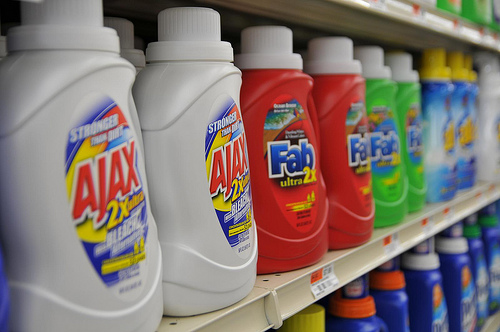
Four Ways to Save Money on Laundry Detergent

by Crystal on March 29, 2010

How do you get good deals on laundry detergent? I have found the occasional good deal, but this seems like the one product I struggle
to really save on. Any advice would be greatly appreciated! Thank you! -A reader

1) Don’t Be Brand Dependent

One of the easiest ways to save money on laundry detergent is to stop being brand dependent and start buying whatever brand you can get on a great sale with a coupon.
My target price for laundry detergent is $2 for a 48-load bottle or larger. By watching for sales on the store-brand at Dillon’s or by pairing a coupon with a great sale on a name-brand, I rarely pay more than that for a bottle of laundry detergent. Aldi and Costco also have good everyday prices on their store brands if you don’t want to mess with watching sales and clipping coupons.
If you can afford it in your grocery budget, stock up when the price is low so that you don’t ever pay retail for laundry detergent again!

2) Use Half of the Recommended Amount

I’m not sure who decided you have to use a full capful of laundy detergent in order to run a load of laundry, but I’m not buying it. In fact, I pretty much always use half the recommended amount–and I think our clothes are plenty clean.
Maybe this is going to sound over-the-top frugal, but it was a trick my mom taught me: when the bottle has almost been used up, add some water, put the lid back on, and shake it up to get the last remains of laundry detergent cleaned out of the bottle. I can usually stretch the bottle to last for another load just by doing this.

3) Only Wash Dirty Clothes

One of the best ways to cut down on your laundry detergent bill–and your water and electric bill for that matter!–is to just stop washing clothes which aren’t truly dirty. We’re not always 100% perfect about this (especially since my 2-year-old has discovered the joy of changing her clothes multiple times throughout the day!), but we try to re-wear clothes whenever we can.
I can often make a pair of jeans last for two to three days without needing to be washed. I just spot-clean them and re-wear them. (I know some people think that is terribly unsanitary, but seriously, who made up the rule that you have to wear an entirely new outfit every single day? If you’re bathing everyday, I really don’t see what’s the big deal. It works for us and it saves us time and money.)

4) Make Your Own

Truth be told, I tried making my own laundry detergent once and it was a total fail. The goopy, baby-spit-up-like solution was not only icky, it did a horrible job of getting our clothes clean. So I gave up that idea and decided to go back to buying detergent on sale with coupons.
However, I have friends who think homemade laundry detergent is the best thing ever. And when I’ve seen the cost breakdowns, I would wholeheartedly agree that it’s very inexpensive to make your own.
Tammy has a great tutorial on making your own laundry detergent. Or, if you’re a visual learner, check out The Simple Dollar’s step-by-step video below:

How do you save money on laundry detergent? I’d love to hear your ideas! (And anyone want to “fess up and tell me that you also re-wear your clothes?!)
photo credit: Pixel Drip

Some Not-So-Obvious Perks to Not Eating Out

by Christina on November 23, 2010 ·in Frugal Living
No Eating Out ChallengeThe following is a guest post by Kate Willson.
Although I did not specifically participate in the No Eating Out Challenge this November, I had actually created my own personal no-restaurants challenge earlier this year. In January, I had just started my first job after graduating from college and was enjoying the independence of living completely on my own without my parents’ help.
After a few months, I quickly realized that dining out several times a week on my entry-level salary was simply not feasible. An avid fan of restaurants, I wondered to myself if it would be possible to go an entire month without once eating out. So I tried it, and I was surprisingly successful. However, just because the month was over, I didn’t want to revert back to my old habits. Here are a few lessons I’ve learned from the No Eating Out Challenge that have continued to instruct me as I navigate the world of living frugally.

1. If you eat out less often and consider restaurant dining a treat, you’ll enjoy the experience more.
I never realized this before I completed the challenge, but restaurant eating had become something of a reflex action for me. As such, I found that I no longer truly enjoyed the experience; even though I was eating out several times a week, I was going to the same restaurants, ordering the same food, and just eating without thinking. However, after completing the challenge, I ate out maybe once a week, and because it had become a less frequent occurrence, I made sure to explore new places, try new things, and just savor the whole process more.

2. Having dinner at home is more effective in strengthening personal relationships than eating out.
While dining out with friends and family can be a great way to socialize, it doesn’t last as long as having dinner at home. In Europe, where service is pretty slow and there’s an emphasis on multiple courses, the dining out experience is by its very nature more social, but not so in America. When you make dinner at home, however, the atmosphere is more relaxed, homey, and better suited to conversation.
3. Knowing exactly what you’re putting into your mouth by dining at home is a great feeling. Although I never thought about it before limiting my dining out experiences, when you eat out, you have so little knowledge and control of what you’re putting in your mouth. Most restaurant meals have tons of added salt and God knows what else. When you make dinner at home, you have a more intimate experience with your food because you purchased the ingredients, prepared them, and cooked them. Seen in this light, eating at home forces you to be more conscious about what foods you select, and you end up just appreciating food more.
While the No Eating Out Challenge may be tough, hang in there. When it’s over with, hopefully you will realize some of the things I did. It will be an experience that not only ends up saving you more money, but it makes you think more deeply about your food, your social ties, and your body.
This guest post is contributed by Kate Willson, who writes on the topics of top online colleges.  
72% of couples under 30 (and in debt) say discussions on household finances always lead to arguments and 43% of them keep some or all of "their debt" seperate from their spouse. ~Mint Study